
Short answer
A mud kitchen is an outdoor play kitchen where children mix real mud, water and foraged plants instead of pretend food. In the UK a well-made wooden one costs £250 to £700, suits children from around age 3 to 10, and needs a solid timber frame, a real sink and an outdoor-grade finish to survive more than one winter. This guide covers every decision, from size and worktop height to paint safety and where to stand it in the garden.
We build mud kitchens for a living, so we hear the same questions every week: how big, how tall, what wood, is the paint safe, will it survive a Yorkshire winter, and is it really worth £500 when there is a plastic one for £60. This guide answers all of them in one place. It is written for UK parents, grandparents and early-years staff who are buying their first mud kitchen and want to get it right the first time.
What a mud kitchen actually is
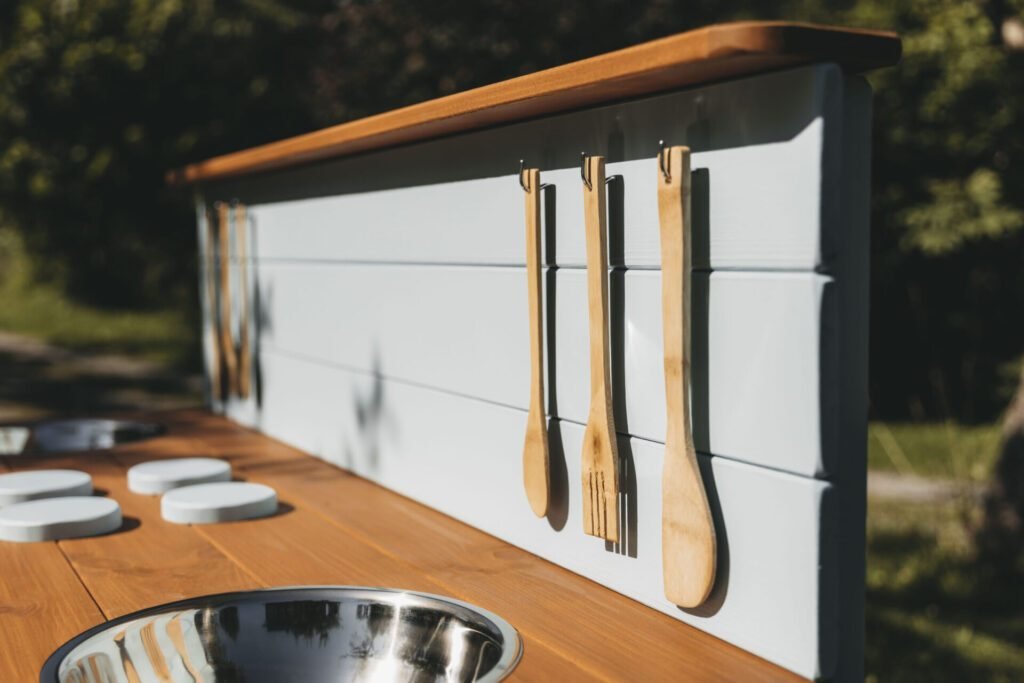
A mud kitchen is a low outdoor bench with a worktop, at least one sink, and somewhere to hang utensils. Children use it to make mud pies, potions, soups and cakes from soil, water, petals, leaves, grass and whatever else the garden offers. There is no right way to play with one, which is exactly the point.
It sits in a category early-years practitioners call open-ended play: the equipment sets a scene but does not script the game. A slide has one use. A mud kitchen has as many uses as the child has ideas, which is why it holds attention for years rather than weeks. Our fuller explainer on what a mud kitchen is covers the developmental side in more detail.
Why UK families keep buying them
Three practical reasons come up again and again in our inbox:
- It works in British weather. Mud play is better in drizzle than in sunshine. A mud kitchen is one of the few garden toys that gets more use in October than in July.
- It gets children off screens without a negotiation. The UK Chief Medical Officers recommend that children aged 5 to 18 average at least 60 minutes of moderate physical activity a day, and that under-fives active on their feet manage at least 180 minutes spread through the day (UK CMO physical activity guidelines). Mud play banks that time without anyone calling it exercise.
- It grows with the child. A three-year-old stirs puddles. A seven-year-old runs a restaurant with a menu, prices and a complaints procedure.
What size mud kitchen do you need
Width is the decision that matters most, because it sets how many children can play without elbowing each other. Everything else can be worked around.
| Worktop width | Children at once | Best for | Our model |
|---|---|---|---|
| 90 to 100 cm | 1 to 2 | One child, tight patios, balconies | Not in our range |
| 120 cm | 2 to 3 | Most family gardens, siblings, playdates | Mud Kitchen 120cm, from £499 |
| 150 cm | 3 to 4 | Big families, childminders, nurseries, schools | Mud Kitchen 150cm, from £529 |
| Two units side by side | 6 to 8 | Nursery gardens, forest school bases | Multi-unit quote |
The honest rule: buy one size up from the number of children you have today. Mud kitchens attract visitors. A kitchen bought for one child will regularly host three.
Do you need storage underneath
An open shelf is cheaper and dries faster. A cabinet with doors hides the clutter and keeps rain off whatever is stored inside. Nurseries almost always choose the cabinet, because an open shelf in a setting with twenty children becomes a mud shelf within a week. Families with small gardens tend to choose it too, because it is the difference between a tidy patio and a permanent yard sale.
The four sizes we build
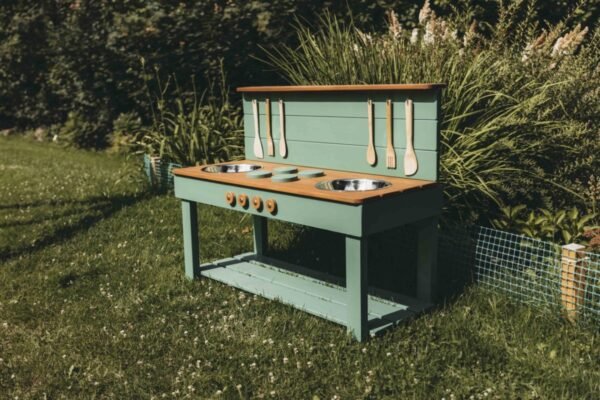
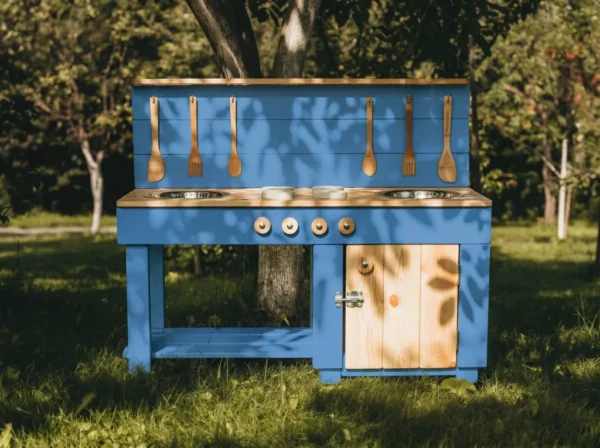
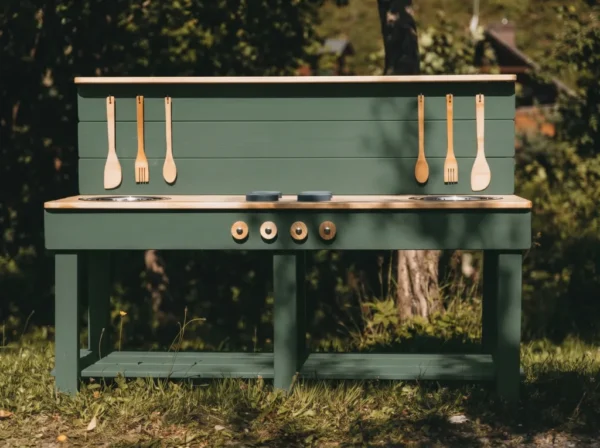
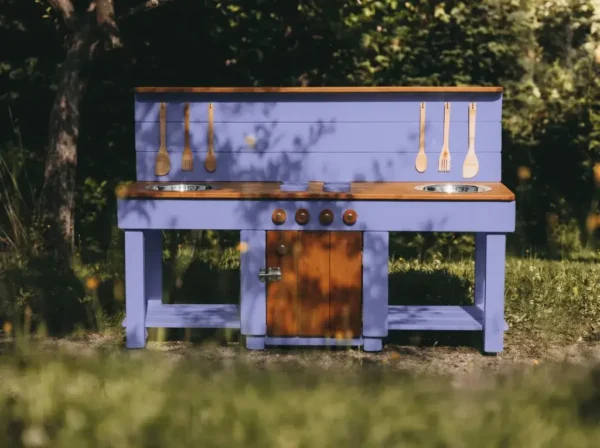
How tall should a mud kitchen be
Worktop height is the most common thing people get wrong, usually by copying an adult kitchen. A child should be able to rest their forearms flat on the worktop without lifting their shoulders. That puts the surface a little below elbow height.
| Child's age | Typical height | Comfortable worktop height |
|---|---|---|
| 2 to 3 years | 85 to 97 cm | 45 to 52 cm |
| 4 to 5 years | 100 to 112 cm | 52 to 60 cm |
| 6 to 7 years | 112 to 125 cm | 60 to 67 cm |
| 8 to 10 years | 125 to 140 cm | 67 to 75 cm |
Because children grow and mud kitchens last, most UK manufacturers settle around 55 to 65 cm, which is comfortable from roughly age 3 to age 8 and still usable at 10 with a slight stoop. If you are buying for a two-year-old, a lower unit or a sturdy step is worth the extra thought. If you are buying for a nursery covering the full 0 to 5 range, a single mid-height unit plus two non-slip steps serves better than two different heights.
Which materials survive a British winter
This is where the price differences come from, and where most disappointment starts.
| Material | Realistic outdoor life | What goes wrong |
|---|---|---|
| Solid softwood (spruce, pine) | 5 to 10 years with basic care | Surface greying, occasional re-coat needed |
| Hardwood (acacia, oak) | 10 years plus | Cost, weight, still needs oiling |
| Plywood | 2 to 4 years | Edges delaminate where water sits |
| Chipboard or MDF | One season | Swells, crumbles, cannot be repaired |
| Moulded plastic | 1 to 3 years | UV makes it brittle and chalky, then it cracks |
The failure point is almost never the timber species. It is the joints, the fixings and the finish. Water finds horizontal end grain, screws that rust bleed black stains down the panel, and a decorative indoor paint blisters by the second spring. We wrote a longer comparison in wooden vs plastic mud kitchens.
What to look for on a spec sheet
- Solid timber, stated as such. “Wooden” is not the same as solid wood. Ask what the panels are.
- An outdoor-rated finish. Exterior acrylic or a purpose-made wood preserver, not an indoor emulsion.
- A real sink you can lift out. A moulded dip in the worktop cannot be emptied, so it becomes a standing puddle.
- Stainless or coated fixings. Plain steel screws rust and stain within a season.
- Sanded, splinter-free edges. Run your hand over a display model. You will know in two seconds.
Is the paint safe for children
Any surface a child under three might mouth is covered in the UK by toy safety rules, and the relevant standard for coatings is BS EN 71-3, which limits the migration of heavy metals such as lead, cadmium and chromium from a toy’s surface. Reputable makers use exterior-grade acrylic wood paints and can tell you what they use.
The practical questions to ask any seller are simple: what paint is on it, is it rated for outdoor use, and has it fully cured before dispatch. Cured exterior acrylic is inert. The risk in a mud kitchen is not the paint, it is the mud, which brings us to hygiene.
Hygiene, honestly
Garden soil is not sterile, and that is fine. Sensible practice, which is what nurseries already do: keep the mud area away from where pets toilet, cover any sand when not in use, discourage eating the produce, and wash hands afterwards. There is a reasonable body of evidence that early exposure to a varied microbial environment is associated with better-regulated immune development, and organisations promoting outdoor learning such as Learning through Landscapes publish practical guidance for settings. Supervise, wash hands, carry on.
Where to put a mud kitchen in the garden
Placement changes how much the kitchen gets used more than any feature on the spec sheet.
- Choose a surface that drains. Grass, bark, gravel or paving with a fall on it. Avoid a dip in a lawn, which becomes a permanent bog.
- Keep it within sight of a window. Play that can be supervised from the kitchen sink happens far more often than play at the bottom of the garden.
- Get water within carrying distance. An outside tap, a water butt or a filled jug on a nearby table. If fetching water is a five-minute round trip, the kitchen will stand dry.
- Put the mud supply next to it. A tub or bay of soil within arm’s reach, so nobody digs up the borders.
- Think about shade and shelter. Under a tree or against a fence extends the season at both ends.
- Leave a metre of clear space in front. Children work in pairs and need somewhere to put the bucket down.
What a mud kitchen costs in the UK
| Price band | What you typically get | Who it suits |
|---|---|---|
| £40 to £90 | Small plastic or thin ply units, supermarket seasonal buys | Trying the idea for one summer |
| £120 to £250 | Flat-pack softwood, thinner panels, self-assembly | Budget-led, expect a re-coat or repair within 2 years |
| £250 to £450 | Solid timber, decent fixings, usually self-assembly | Good middle ground for one child |
| £450 to £700 | Solid timber, real sinks, outdoor finish, often delivered assembled | Multi-child families and settings buying once |
| £700 plus | Bespoke, hardwood, or commercial early-years units | Nurseries, schools, forest school sites |
Cost per year of use is the more useful number. A £70 plastic kitchen that fails after one season costs more per year than a £499 solid one still standing after eight. That is the whole argument, and it is worth doing the sum with your own numbers rather than taking ours.
Buying versus building your own
Building one from pallets is a genuinely good weekend project if you already own a drill, a saw and a sander, and if you can source heat-treated pallets marked HT rather than chemically treated ones marked MB. Budget realistically for exterior screws, an outdoor finish, a sink, hinges and hooks. Most self-builders we speak to spend £80 to £150 on materials and a full weekend, and end up with something they are proud of.
Buy instead if you want it to arrive finished, if you do not have the tools, or if you need it to survive institutional levels of use. Neither answer is wrong. We ran the full cost comparison here.
Keeping it alive: care through the year
- Every play session: tip out the sinks so water is not standing overnight.
- Monthly in summer: brush off dried mud, check the utensil hooks are tight.
- Autumn: clear leaves from the shelf, check the feet are not sitting in a puddle, fit a cover if you have one.
- Every 1 to 2 years: a fresh coat of exterior wood care on any worn edges, ideally on a dry spring weekend.
Full detail, including which products to use, is in our weatherproofing and winter care guide.
Mud kitchens in nurseries and schools
The statutory Early Years Foundation Stage framework requires settings to provide daily outdoor activity, and mud kitchens map neatly onto several areas of learning at once: physical development through pouring and mixing, communication and language through the running commentary that accompanies every mud pie, and understanding the world through weather, plants and change of state.
Procurement differences that matter for settings: invoicing rather than card payment, multi-unit pricing, delivery assembled so no one loses a day to flat-pack, and a build that tolerates twenty children a day rather than two. Our nurseries and schools page covers how we handle that, and our EYFS guide covers setup and risk assessment.
Free printable
The Mud Kitchen Buyer's Checklist
Fourteen things to check before you buy any mud kitchen, ours included. Take it to a showroom, or run a product listing through it in five minutes.
- Materials, fixings, sinks and finish
- The three questions to ask about paint
- Space and height planner on the back
Buying for a particular age or space? See toddlers, older kids, small gardens and storage models.
Frequently asked questions
What age is a mud kitchen suitable for?
Most mud kitchens suit children from age 3 to around age 10. Under-threes enjoy them with close supervision and a lower worktop or a step. The play changes with age: toddlers pour and stir, while older children invent recipes, menus and restaurant games.
Can a mud kitchen be left outside all year in the UK?
Yes, if it is built from solid timber with an outdoor-grade finish and stainless fixings. Tip out standing water, keep the feet off waterlogged ground, and re-coat worn edges every one to two years. A fitted cover extends its life through winter but is not essential.
How much should I spend on a mud kitchen?
Expect £250 to £450 for a solid timber kitchen for one child, and £450 to £700 for a wider unit with real sinks that arrives assembled. Units under £120 are usually plastic or thin ply and rarely last more than one or two seasons outdoors.
Do mud kitchens need a water supply?
No plumbing is required. Children carry water in jugs, watering cans or a small dispenser with a tap. Lift-out sink bowls are filled and emptied by hand, which is part of the play and lets you control how much water goes into the garden.
What is the best wood for a mud kitchen?
Solid softwoods such as spruce and pine offer the best balance of cost, weight and outdoor durability, lasting 5 to 10 years with a re-coat. Hardwoods last longer but cost far more. Avoid chipboard, MDF and thin plywood, which swell and fail within a season or two.
Where to start
If you take three things from this guide: buy solid timber, buy one size wider than you think you need, and put it somewhere that drains and can be seen from the house. Everything else is detail.
Not sure which size fits your garden? Email sales@mudkitchenexpert.co.uk with a photo of the space and roughly how old the children are, and we will tell you honestly which of the four we would put there, or whether you need one at all. You can also see all sizes and colours at our Bognor Regis showroom.