
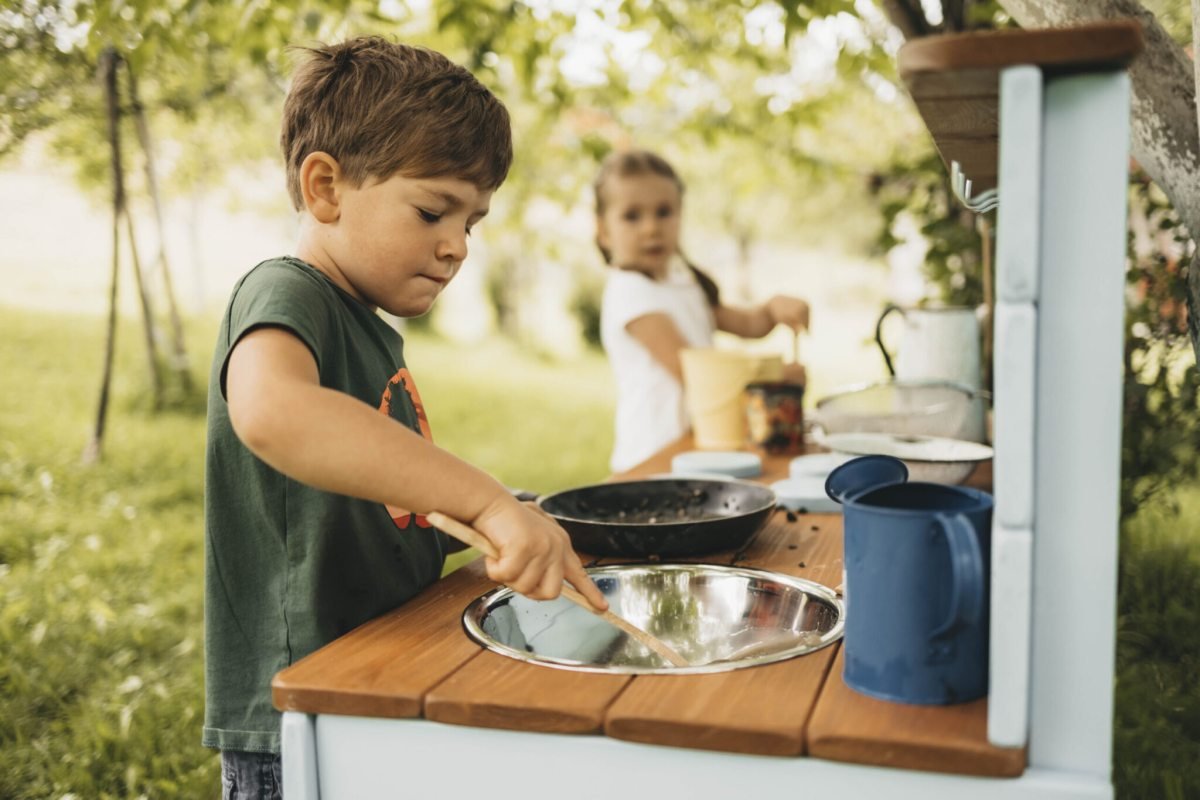
Short answer
The garden toys that actually get used change with age: at one and two it is water, sand and things to push; at three the mud kitchen becomes the centre of the garden and stays there until eight or ten; from four, climbing and swinging join in; from six, bikes, balls and anything with rules. The best value across the whole decade is the small number of open-ended things (mud, sand, water, loose parts, something to climb) rather than a new toy every year.
How to read this page
This is a guide to what children in each age band play with in a British garden, based on what we see from the families and nurseries we supply and on the play research we have collected in our outdoor play statistics. It is deliberately not a list of products. Most of the best garden play at every age is the same handful of things used differently. Where a mud kitchen fits, we say so, and where something else is the better buy first, we say that too.
| Age | What they play | What is worth buying | Skip for now |
|---|---|---|---|
| 1 to 2 | Pouring, filling, pushing, watching | A water tray, a sand tray, a push-along, a small watering can | Mud kitchen, anything with rules |
| 2 to 3 | Pouring with purpose, first pretend play | A mud kitchen with an adult alongside, buckets and spades, a small slide | Bikes, climbing frames |
| 3 to 5 | Pretend play, mixing, cooking, first shared games | A mud kitchen, a sand pit, a swing, balance bike | Trampoline |
| 5 to 8 | Cafes, potions, science, dens, ball games | A bigger mud kitchen, a climbing frame, a bike, den-building kit | Very little; this is peak garden age |
| 8 to 10 | Games with rules, building, experiments, hanging out | Goal, basketball hoop, a proper den, tools, the mud kitchen as a lab | Toddler-scaled anything |
Ages 1 to 2: water, sand and a small watering can
A one-year-old outdoors wants to fill, empty and pour. A washing-up bowl of water on the lawn does most of it. A sand tray does the rest. The only “toy” worth money at this age is a good two-litre watering can, because it is the one they will still be using at six. A mud kitchen is too early for most one-year-olds: the worktop is above their reach and the play is still solo. Buy it for the second or third birthday instead. We wrote about whether to buy a mud kitchen, a sand table or a water table first, and at this age the answer is usually the water table.
Ages 2 to 3: the mud kitchen arrives
Somewhere between two and three, pretend play starts. Pouring becomes “making tea”. Mud becomes “cake”. That is the moment a mud kitchen turns from a piece of furniture into the centre of the garden. Buy it now with an adult playing alongside, or wait for the third birthday and let them loose. Our page on mud kitchens for toddlers covers the timing and the safety questions in detail.
Ages 3 to 5: the golden years
This is the age the garden becomes the child’s. A mud kitchen, a sand pit and something to swing on cover most afternoons for two years. Everything else is loose parts: pots, pans, sticks, stones, petals, a bucket, a length of guttering. Our cost per hour of play index ranks sixteen common garden toys, and the three that come out cheapest across the years are all in this list.
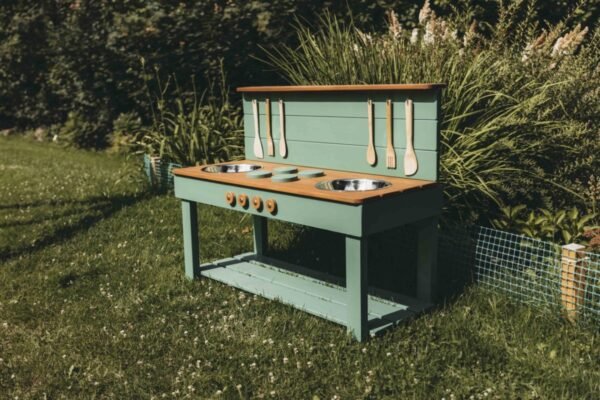
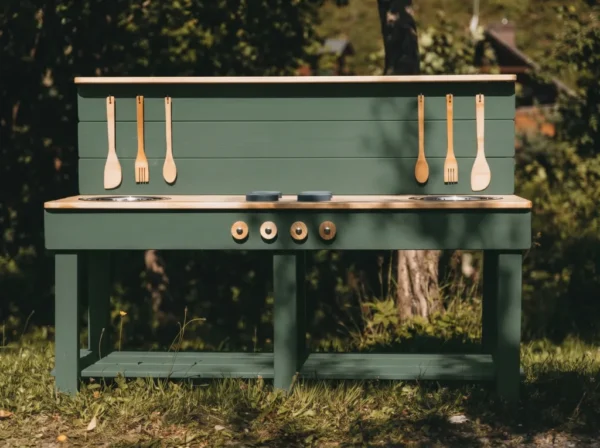
The two mud kitchens most families buy at three
Ages 5 to 8: more room, more rules
Play gets social and elaborate. The mud kitchen becomes a cafe with a menu, a potions lab, a bakery with prices. Friends come round and three children need to fit at the worktop, which is why the 150 cm kitchen earns its place at this age. Alongside it, a climbing frame or a swing set, a bike, and the beginnings of den-building. See our page on mud kitchens for older kids for what changes after five.
Ages 8 to 10: games, building and the lab
The mud kitchen is still there, but now it is a laboratory: bicarbonate volcanoes, sieved “flour”, dye from petals, measured recipes. Around it the garden fills with things that have rules: a goal, a hoop, a target, a proper den with real tools. Most children lose interest in the kitchen itself somewhere between eight and ten, which, if you bought it at three, is six or seven years of weekly use from one purchase. Our best garden toys for kids UK guide ranks the whole field on play value.
The buying rule that works at every age
Buy the open-ended things once and buy them well. Mud, sand, water, loose parts, something to climb. Those five cover a decade, and they are the reason a solid timber mud kitchen at £499 is cheaper per hour of play than almost anything else you will put in a garden. Everything else can be borrowed, bought second-hand, or skipped. For the wider picture, our garden play hub has every guide in one place.
Frequently asked questions
What age are garden toys for?
There is something for every age from one upwards, but the toys that last are the open-ended ones: water and sand from one, a mud kitchen from two or three, climbing and swinging from four, and games with rules from six.
What is the best garden toy for a 3 year old?
A mud kitchen. It is the age the play becomes independent and pretend, and a good one is still in use at eight. A sand pit and a small swing are the usual companions.
Which garden toys are a waste of money?
Anything scaled for a single year, plastic that will crack in a winter, and toys with a single use. A trampoline is popular but gets used far less per pound than a mud kitchen or a climbing frame over the years.
Do older children still use a mud kitchen?
Yes, until around eight to ten, usually as a cafe, a potions lab or a science bench. Older children need more worktop, which is why we recommend the 150 cm model from age five.