
Short answer
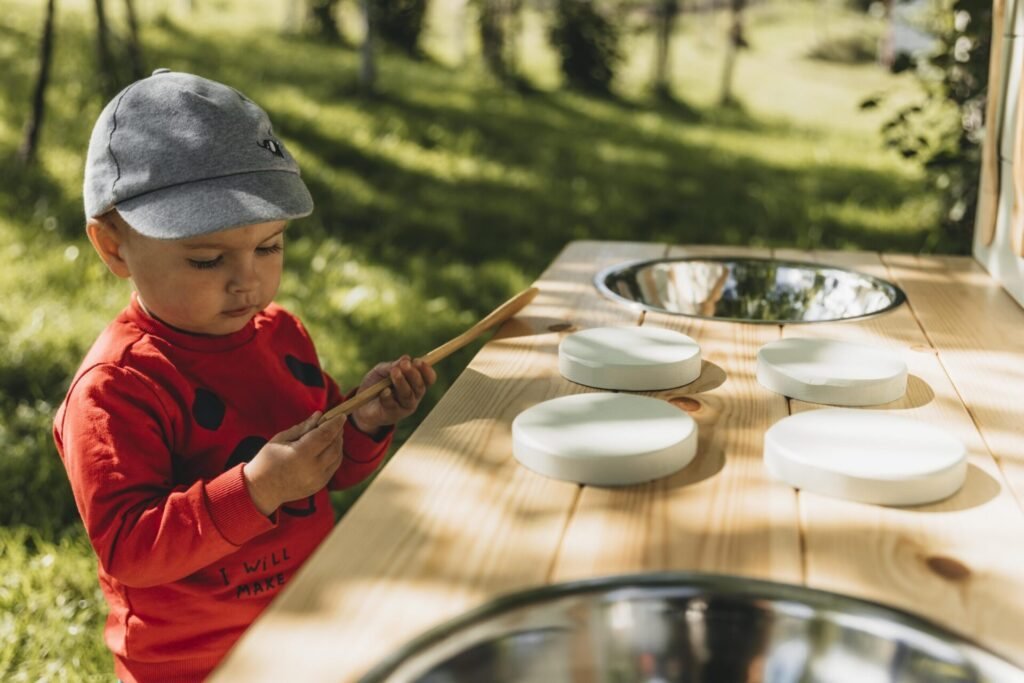
A mud kitchen is an outdoor play kitchen where children cook with real mud, water, petals and leaves instead of pretend plastic food. It usually has a worktop, at least one sink, a few painted burners and hooks for utensils. It is the most-used piece of equipment in most nursery gardens because the play is open-ended: the kitchen sets the scene but never dictates the game, so it holds a child’s attention from about age 3 to age 10.
If you have seen one in a nursery garden or on someone’s lawn and wondered what the fuss is about, this is the explanation. No sales pitch until the end, and you can tell where that starts.
What a mud kitchen is
Physically it is simple: a low bench, a worktop, one or two sinks, somewhere to hang spoons, and a shelf underneath. What makes it a mud kitchen rather than a garden table is that the ingredients are real. Soil, water, grass, petals, seed heads, fallen apples, conkers. Nothing is pretend except the eating.
That is the whole design. Everything else, the burners, the hooks, the utensils, exists to suggest a kitchen strongly enough that the child’s imagination does the rest.
Why it holds attention when other garden toys do not
Early-years practitioners call this open-ended play, and the distinction is worth understanding because it explains the value.
| Closed-ended equipment | Open-ended equipment |
|---|---|
| A slide. One correct use. | A mud kitchen. As many uses as the child has ideas. |
| Interest peaks in the first fortnight. | Interest deepens as the child develops. |
| Play looks the same at 3 and at 7. | Play at 7 looks nothing like play at 3. |
| Outgrown. | Reinvented. |
A three-year-old at a mud kitchen stirs and pours and names things. A five-year-old invents recipes and cooks for an audience. A seven-year-old runs a restaurant with a menu, prices and strong opinions about the service. Same object, three completely different games.
What children actually get out of it
- Language, in volume. This is the effect practitioners mention first. Mud kitchens generate constant narration, negotiation and instruction giving, often from children who say very little indoors.
- Physical development. Carrying a full watering can, scooping, stirring stiff mud and pouring accurately work gross and fine motor control at the same time.
- Early maths. Capacity, more and less, counting portions, sequencing a recipe, comparing weights. All of it incidental and none of it presented as maths.
- Understanding the world. Where soil comes from, what rain does, why the mixture is different in August and in November.
- Time outdoors. UK Chief Medical Officers recommend under-fives are active for at least 180 minutes spread across the day (CMO physical activity guidelines). Mud play banks that without anyone calling it exercise.
Where it came from
Mud kitchens arrived in UK gardens through early-years practice rather than the toy industry. Forest school and outdoor learning approaches, and the Scandinavian tradition of outdoor provision in all weathers, put messy natural play at the centre of the early years, and the statutory Early Years Foundation Stage framework requires settings to offer daily outdoor activity. Nurseries built them, parents saw them, and the domestic market followed. That is why the good ones still look like nursery equipment rather than toys.
What a good one has
- Solid timber, not chipboard or MDF. Both swell and crumble in one wet season.
- A real, removable sink. Not a moulded dip, which holds standing water and cannot be emptied.
- An outdoor-grade finish. Exterior acrylic or a proper wood preserver, not indoor emulsion.
- A worktop 5 to 10 cm below the child’s elbow. Height is the thing people most often get wrong.
- Stainless fixings. Rusting screws split timber and stain every panel.
- Enough width. 120 cm for two or three children, 150 cm for three or four.
Our complete UK buying guide works through all of these with prices and dimensions.
Is it a lot of mess
Yes, and that is the point, but it is containable. Stand it on grass, bark or gravel rather than beside a pale patio door. Keep a lidded tub of prepared soil next to it so nobody digs up the borders. Keep one pair of dedicated wellies and a cheap waterproof all-in-one by the back door. Tip the sinks out at the end of play. That is genuinely the whole system, and it is what nurseries do.
Our guide to making the mud itself covers the soil to use and the mixtures that wash out of clothes most easily.
Is it worth the money
A solid timber mud kitchen costs £250 to £700 in the UK and lasts 5 to 10 years outdoors with basic care. A supermarket plastic one costs £40 to £90 and typically lasts one or two seasons. Divide either by the years you get and the comparison changes shape, which is why we published the wooden versus plastic breakdown.
The more honest test is how often it will be used. A mud kitchen that lives on the lawn and is played with twice a week for six years is one of the cheapest things per hour in the garden. One that sits in a shed is not.
Frequently asked questions
What is a mud kitchen?
A mud kitchen is an outdoor play kitchen where children cook with real mud, water, petals and leaves rather than pretend food. It typically has a worktop, one or two sinks, painted burners and hooks for utensils, and it is used for imaginative cooking play from around age 3 to age 10.
What is the point of a mud kitchen?
It supports open-ended play, meaning the equipment sets the scene but does not dictate the game. That produces a high volume of language and collaboration, develops fine and gross motor skills through pouring and carrying, and keeps children outdoors in weather that would otherwise keep them in.
What age is a mud kitchen for?
Mud kitchens are rated for ages 3 and up and are most used between 4 and 8, with older children continuing to play at them into their tenth year. Under-threes enjoy them with close supervision and a wide non-slip step.
Do you put real mud in a mud kitchen?
Yes. Real soil mixed with water is what makes it a mud kitchen. Peat-free topsoil or sieved garden soil works best, kept in a lidded tub beside the kitchen. Cocoa and flour, oats or wet play sand are good alternatives where there is no soil, such as on a balcony.
If you have decided you want one. We build four sizes in solid spruce, hand-painted in eleven outdoor colours, with two lift-out steel sinks, delivered fully assembled and free anywhere on the UK mainland. See the range or read the full buying guide first.
Ready to choose a mud kitchen? Four sizes, eleven hand-painted colours, free UK delivery, delivered fully assembled. Browse the collection.