
Short answer
A mud kitchen for older children, from about five to ten, needs more worktop, more sink and more to do: room for two or three friends to run a cafe, real steel bowls for proper washing up, burners and knobs that support a longer game, and a build that survives being leaned on by a nine-year-old. Our 150 cm models, from £529, are the ones we recommend for this age; a well-made kitchen bought at five is still in use at ten.
What changes after five
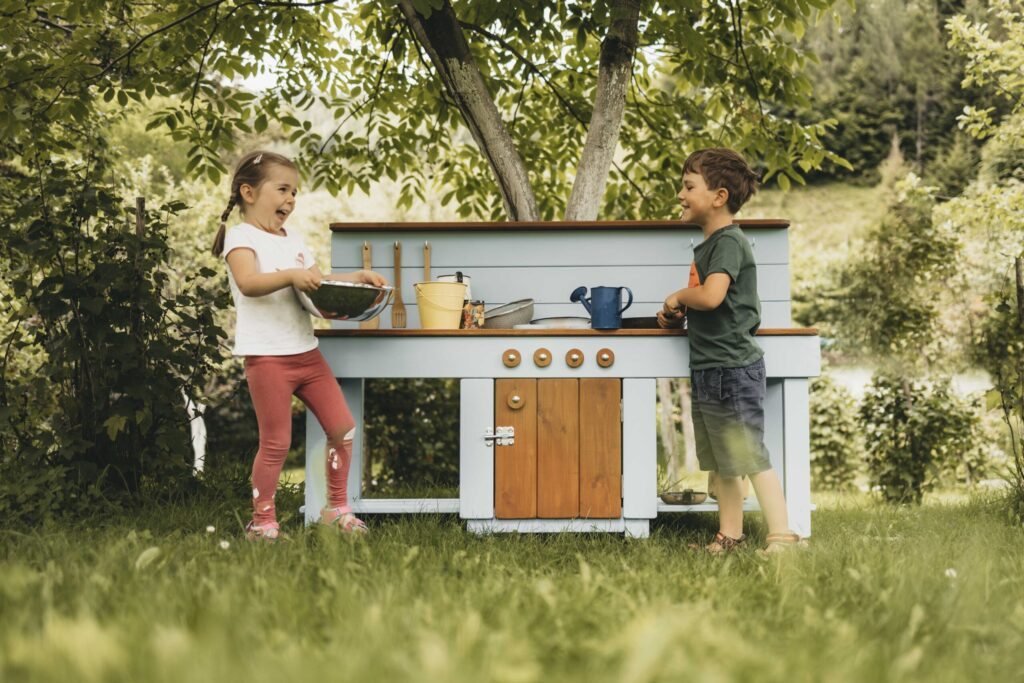
A three-year-old at a mud kitchen pours. A six-year-old runs a business. The play gets longer, more social and more elaborate: menus written in chalk, a queue of customers, prices, potions with rules, a science lab on Tuesdays. The kitchen has to keep up with that, and most “toddler” mud kitchens do not.
Three things start to matter that did not before.
| At 3 | At 6 to 10 | What the kitchen needs |
|---|---|---|
| One child, one game | Two or three friends, one shared game | 150 cm of worktop, two sinks |
| Pouring | Washing up, sieving, straining, measuring | Real steel bowls that hold a proper amount of water |
| Ten minutes | An hour | A solid worktop that takes leaning, climbing and enthusiasm |
Why the 150 cm is the older-child kitchen
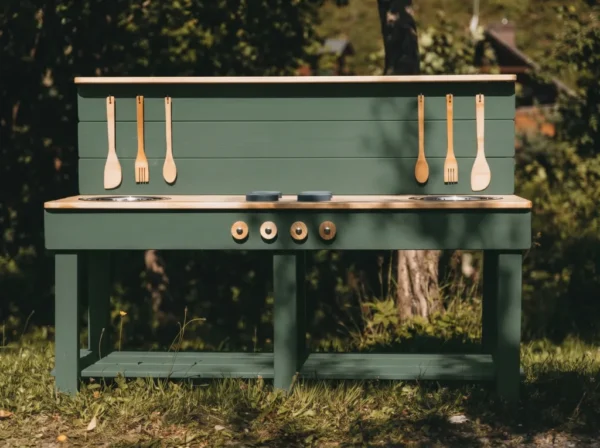
Our 150 cm kitchen has the same build as the 120 cm, with 30 cm more worktop. That sounds like a small difference. In practice it is the difference between two children and three, and between a kitchen where the pans have to be moved to make space and one where the sink, the hob and the prep area all work at once. Read the detail on our large mud kitchens page.
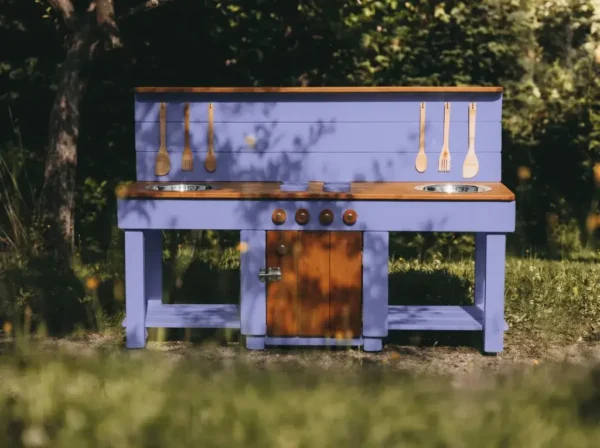
The 150 cm with Storage Cabinet adds a closed cupboard underneath. Older children accumulate kit: sieves, measuring jugs, a mortar and pestle, a colander, a whole shelf of potion ingredients in jars. A cabinet keeps it in one place and gives the end of the session somewhere to go.
The two we recommend from age five
Making it interesting for a seven-year-old
The kitchen is the stage. What keeps an older child at it is the material and the mission. Some things that work, from families and from the nurseries we supply:
- A chalkboard menu. A slate or blackboard sheet on the fence beside the kitchen. The cafe game runs on it.
- Measuring kit. A jug with markings, a set of spoons, a balance scale. Mud pies become recipes, and recipes become maths without anyone saying so.
- A sieve and a colander. Sifting soil into fine “flour” is the most absorbing thing an eight-year-old can do outdoors.
- Potion rules. Coloured water, petals, dried herbs, a book of spells written by the child. The free recipe cards include the older-age ones.
- A science day. Bicarbonate of soda, vinegar and food colouring at a mud kitchen sink is the best volcano there is, and easier to clean than one in a kitchen.
Our guide to mud kitchen accessories ranks the kit by age, and the mud kitchen party plan has a whole running order for ages up to eight.
Built for a nine-year-old
An older child leans on the worktop, climbs on the shelf to reach the rail, and drags the kitchen across the patio to a better spot. Solid spruce boards, fixed together and delivered as one assembled piece, take that. Thin ply, flat-pack joints and plastic feet do not. That is also why we do not use chipboard or MDF anywhere: a kitchen that will be used until age ten has to survive six or seven British winters, and those materials manage one.
The paint is an exterior acrylic wood finish that does not flake, so a kitchen bought for a five-year-old still looks like itself when they are nine. Our guide to weatherproofing covers the one-hour annual routine that keeps it that way.
Frequently asked questions
What age do children stop using a mud kitchen?
Most children lose interest somewhere between eight and ten, and a good number keep using one for science and potion play until eleven. A kitchen bought at three or four is typically in use for six or seven years.
Is a 120 cm mud kitchen too small for a 6 year old?
Not for one child. For a six-year-old who plays with friends or siblings, the 150 cm gives the extra room a shared game needs, and it is the model we recommend from five upwards.
Is a mud kitchen a good present for a 7 year old?
Yes, especially if it is presented as a cafe or a laboratory rather than a toy. Pair it with a chalkboard and some measuring kit. Our gift guide covers what to add for each age.
Will an older child break it?
Not a solid timber one. Our kitchens arrive fully assembled and are built to be leaned on and climbed on by primary-age children. The parts that wear are the accessories, which are cheap to replace.