
Short answer
The best garden toys for children in the UK are the ones that get used in November as well as June, that more than one child can play with at once, and that do not dictate the game. By those tests the strongest buys are a mud kitchen, a sandpit with a lid, a water table or a couple of big tubs, a climbing frame or swing, a set of balls, chalk and a bucket of loose parts. Trampolines and paddling pools score high on excitement and low on hours of use per pound. Below, each one is scored on play value, age range, weather and cost per hour.
We make one garden toy, so this is not a neutral list. What it is, honestly, is the list we would write for a friend with a new garden and a budget, including the things we do not sell. Every item is scored on the four things that actually predict whether it gets used.
How we scored them
- Play value: does it suggest a game or script one? Open-ended equipment holds attention for years; single-use equipment for weeks.
- Age range: how many years of a childhood does it cover.
- Weather: is it usable in a British October, or only in a heatwave.
- Cost per hour: price divided by realistic hours of use over its life. This is the number that matters and the one nobody publishes. The full index is here.
The ranking
| Toy | Play value | Age range | All weather | Cost per hour | Verdict |
|---|---|---|---|---|---|
| Mud kitchen (solid timber) | Open-ended | 3 to 10 | Yes, better in wet weather | About 40p | The one we would buy first |
| Sandpit with lid | Open-ended | 1 to 8 | Mostly | About 30p | Cheap, brilliant, needs a lid or cats find it |
| Water table or two big tubs | Open-ended | 1 to 6 | Spring to autumn | About 25p | Pair it with the mud kitchen |
| Climbing frame or swing | Physical | 3 to 12 | Yes | About 50p to £1 | The other big-ticket item worth it |
| Balls, a goal, chalk | Open-ended | 2 to 12 | Yes | Under 10p | Do not overthink this |
| Loose parts bucket | Open-ended | 2 to 10 | Yes | Under 5p | Pots, pans, pipes, crates, guttering |
| Trampoline | Physical, single use | 5 to 14 | Dry days only | About £1 to £2 | Loved, then ignored, then a hazard |
| Paddling pool | Single use | 1 to 8 | Heatwaves only | £3 plus | Ten hot days a year |
| Ride-on cars and plastic slides | Single use | 1 to 4 | Dry days | About £1 | Outgrown in two summers |
| Playhouse | Open-ended | 2 to 8 | Yes | About 60p | Good if solid timber, poor if plastic |
The five we would actually buy
1. A mud kitchen
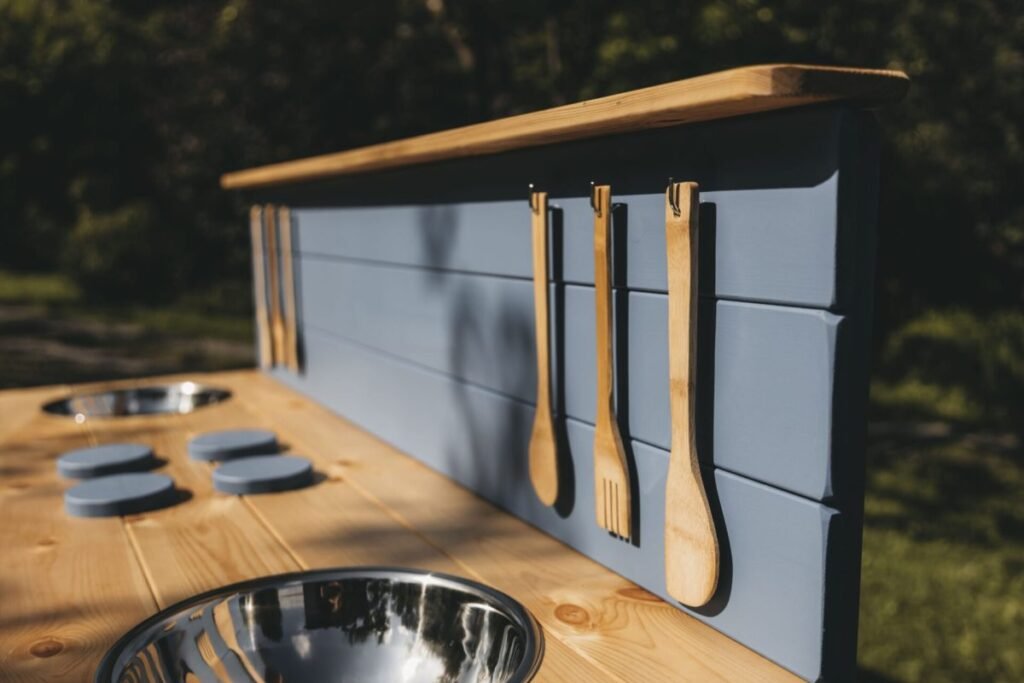
Obviously we would say that. The reasons it tops the list are not ours, they come from early-years practice: it is open-ended, it works in all weathers, it covers ages 3 to 10, and it generates more language and collaboration than any other single piece of garden equipment. Buy solid timber with real sinks or do not bother. The full buying guide explains why.
2. A sandpit with a lid
Second only because it needs the lid, and because sand travels indoors in a way mud does not. A sunken one in a corner, or a timber box on the patio, either works. Budget £60 to £150 plus sand. Put it next to the mud kitchen and the two become one play area.
3. Water, in any container
A water table is nice, and the full three-way comparison is in our mud kitchen vs sand table vs water table guide. Two large builders’ trugs on a bench are nearly as good at a tenth of the price. Pouring, filling, tipping and floating is the play, and the container is incidental. Add a jug, a sieve and a funnel.
4. Something to climb
A swing, a rope, a climbing frame, a low beam, a decent tree. Children need to hang, swing, balance and jump, and a garden that offers that gets used. Solid timber frames from £250 upwards last a decade. Choose one with a swing and a platform rather than every attachment in the catalogue.
5. Loose parts
The cheapest and most underrated. A crate of pots, pans, lengths of guttering, plastic pipe, planks, tyres, milk crates and a tarpaulin. It looks like junk and it is the raw material for dams, dens, shops, rockets and marble runs. Restock from the charity shop and the skip.
The ones that disappoint
Trampolines are the biggest garden toy purchase most families make and the one with the shortest half-life. Six weeks of frenzy, then it becomes the thing in the corner with a green net. They also account for a large share of children’s A&E visits from garden play, mostly when more than one child bounces at once. If you buy one, buy one with an enclosure and enforce one at a time.
Paddling pools get used on ten hot days a year, take twenty minutes to fill, and kill a circle of lawn. Good fun on those ten days. Not a garden toy, a heatwave toy.
Plastic playhouses and slides are outgrown by four, go chalky in UV, and end up on a driveway with a “free to collector” sign. Solid timber versions of the same thing last and resell.
Building a garden that gets used
The pattern behind the list: buy open-ended before single-use, solid before plastic, and things that work in the rain before things that need sun. Put the messy zone (mud, sand, water) together in one corner near the house, and the physical zone (climbing, swinging, balls) on the grass. Keep a crate of loose parts between them. That is a garden a child uses every week for a decade, and it costs less than a trampoline and a paddling pool.
For the same field sorted by age, see garden toys by age.
Frequently asked questions
What is the best garden toy for a 3 year old?
A mud kitchen or a sandpit, because both are open-ended and work in most weathers. Add a jug and a couple of tubs for water play. At three, physical play is covered by a low swing or a small slide, but the messy play area is what gets used daily.
What garden toys last the longest?
Solid timber equipment: mud kitchens, climbing frames, sandpits and playhouses all last 5 to 10 years or more if they are real wood with an outdoor finish. Plastic equipment goes brittle in UV within two or three summers. Balls, chalk and loose parts last as long as you keep replacing them.
Are trampolines worth it?
They are loved for the first six weeks and then used far less, and cost £1 to £2 per hour of use over their life. They also carry a real injury risk when more than one child bounces. A climbing frame or swing gives similar physical play, lasts longer and is used more consistently.
What outdoor toys can be used in winter?
Mud kitchens, sandpits with a lid, climbing frames, swings, balls and loose parts all work in a British winter with the right clothing. Water tables, paddling pools and trampolines are fair-weather equipment. A mud kitchen is arguably better in winter than in summer because the mud is the right texture.
Starting with the mud kitchen? Four sizes in solid spruce, two steel sinks, eleven colours, delivered assembled. See the range, or read our garden play hub for the rest.
Ready to choose a mud kitchen? Four sizes, eleven hand-painted colours, free UK delivery, delivered fully assembled. Browse the collection.