
Short answer
If you are choosing one, choose the mud kitchen: it does everything a sand table and a water table do, plus role play, and it holds attention for years rather than months. A water table is the best value for under-twos, a sand pit earns its place in bigger gardens as a second station, and a sand table on legs is the weakest of the four for most families. Here is the honest comparison for a British garden.
These three get compared constantly, usually in a toy aisle with a child pulling on one arm. They look similar, plastic or wood, waist height, something to scoop. They are not similar in what they do for play, how long they last, or how they cope with a UK winter. We sell one of the three, so read this knowing that, but the reasoning is all here to check.
What each one actually is
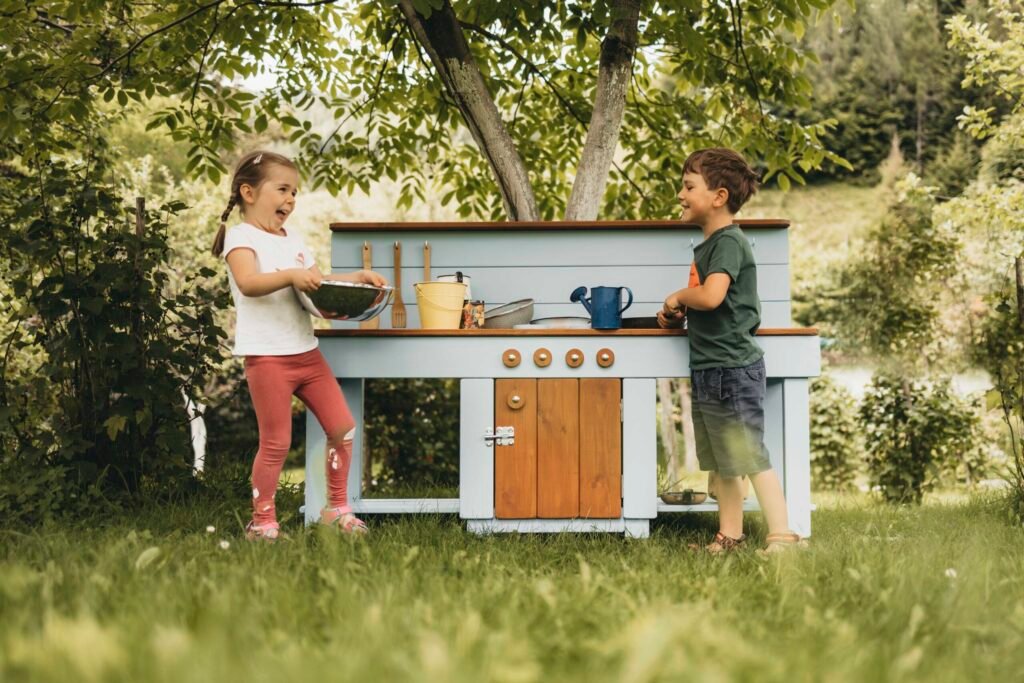
- Mud kitchenA worktop with sinks, burners and shelves, used with soil, water and whatever the garden offers. Play is open-ended cooking, mixing, role play. Usually solid wood, 300 to 600 pounds handcrafted, or DIY.
- Water tableA moulded plastic tray on legs with channels, wheels and funnels. Pouring and splashing for toddlers. 25 to 90 pounds, almost always plastic.
- Sand tableThe same tray idea filled with sand, sometimes half sand half water. 30 to 100 pounds.
- Sand pitThe ground-level version: a frame or shell full of sand. Digging, burying, building. 40 to 150 pounds plus sand.
The comparison that matters
| Criterion | Mud kitchen | Water table | Sand table or pit |
|---|---|---|---|
| Age range | 3 to 10, toddlers with help | 18 months to 4, then abandoned | 2 to 8 for a pit, less for a table |
| Play type | Open-ended role play, no fixed outcome | Cause and effect pouring | Construction and digging |
| Attention span | 30 to 90 minute sessions are normal | 10 to 20 minutes | 20 to 40 minutes |
| UK weather | Solid wood lives outside year round | Plastic fades and cracks, needs emptying | Sand needs a cover or it becomes a litter tray |
| Lifespan | 5 to 10 years, hand-me-down | 1 to 3 seasons | 3 to 6 years with a good cover |
| Mess location | Contained at the worktop and sinks | Water everywhere, self-draining | Sand migrates into the house for years |
| Sibling spread | A 5-year-old and a 9-year-old use it differently at once | Youngest only | Decent, digging scales with age |
Why the mud kitchen wins as the single purchase
The short version: the other two are inside it. Two lift-out stainless sinks are a water table when filled, and a dry mix of sand or compost on the worktop is the sand play. What the trays cannot do in return is the cooking, the café, the potion lab, the birthday cake for the dog, the entire imaginative layer that keeps a seven-year-old at a station a toddler also uses. That layer is why attention spans at a mud kitchen are measured in half hours, not minutes, and why our cost per hour index puts a solid wood kitchen among the cheapest garden equipment per hour of real play despite the higher ticket price.
The honest caveats: a mud kitchen needs a water source nearby (a jug and a butt will do, see water play without plumbing), it is messier than a water table on a patio, and a good one costs several times a plastic tray. If the budget is 50 pounds, buy the water table and enjoy it, then upgrade around age three when it stops working.
When the others are the right call
- Water table: the child is under two and the garden is a balcony or patio. Pouring is the whole game at that age and the table drains and stores flat. Expect to pass it on by age four.
- Sand pit: you have the space for two stations and a lid you will actually use. Digging is a different play muscle to cooking, and the combination of pit plus kitchen is the best-equipped garden a child can have. A pit, not a table: table sand dries out, holds less, and removes the best part, sitting in it.
- Sand table: honestly, rarely. It is the water table’s shape without the water table’s point, and the mud kitchen does its mixing better with more room.
Can you have sand in a mud kitchen?
Yes, and you should. A tub of play sand in one sink gives the dry texture, soil in a trug gives the wet one, and the mix of the two is the professional-grade mud pie. The recipe thinking is in how to make the mud. Keep sand and soil in lidded tubs under the worktop, a storage cabinet earns its 50 pounds here, see storage or open shelf.
Frequently asked questions
Is a mud kitchen better than a water table?
For children of three and over, yes, clearly: it does the pouring a water table does through its lift-out sinks, and adds the role play that holds attention for years. For a child under two, a water table is the better first buy, cheaper and exactly matched to how toddlers play, with the kitchen as the upgrade at around three.
Sand pit or mud kitchen first?
Mud kitchen first for most families: broader age range, richer play, and it works in winter when a sand pit is under its cover. Add the pit as the second station if the garden allows, the two together cover almost every kind of outdoor play a primary-age child asks for.
What age is each toy right for?
Water tables suit 18 months to about 4. Sand pits run from 2 to about 8. A mud kitchen runs from about 3 to 10, with toddlers joining in supervised, which is the widest window of the three, worktop heights and ages are in our age guide.
Do any of them survive a UK winter outdoors?
A solid wood mud kitchen with outdoor paint is the only one designed to: it lives outside year round, ideally with a cover. Plastic tables go brittle in frost and should be stored, and sand needs a fitted lid through winter or it will not be sand you want by March.
Decided? Four handcrafted kitchens in solid spruce, eleven colours, delivered fully assembled with free UK mainland delivery. See the range, or put any of them through the free buyer’s checklist first.
Ready to choose a mud kitchen? Four sizes, eleven hand-painted colours, free UK delivery, delivered fully assembled. Browse the collection.