Short answer
Choose a mud kitchen with a storage cabinet if the kitchen will live in view of the house, if the garden is small, or if it is for a nursery or childminder. Choose the open shelf if you want the pots visible so they get used, if drying speed matters more than tidiness, or if you want to spend £50 less. On our kitchens the cabinet adds £50 on either width, keeps rain off what is stored, and turns the kitchen into the garden’s toy cupboard. Both versions are the same solid spruce build with the same two steel sinks.
It is the second most common question we get after “which width”, and it is the one people change their mind about most often after delivery. Here is the honest case for each, with the situations where one clearly beats the other.
What the cabinet actually is
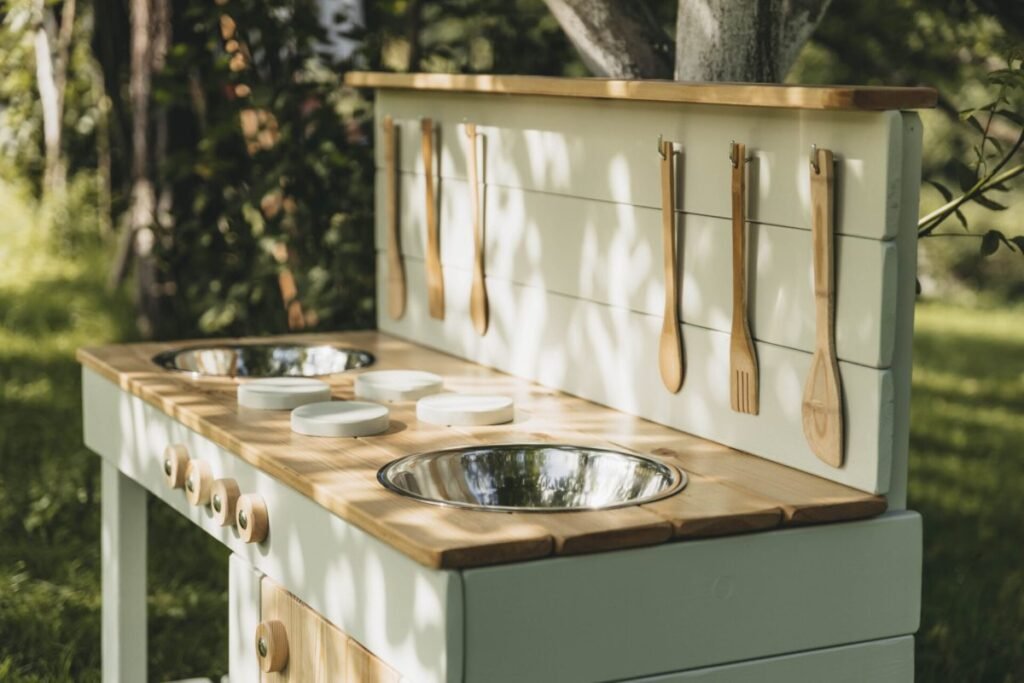
Underneath the worktop, instead of an open full-width shelf, the storage models have a cupboard with two doors. Same height, same footprint, same worktop, same sinks and burners. The difference is entirely below the waist, and it is the difference between a garden that looks tidy and a garden that looks like a mud kitchen is in it.
| Open shelf | Storage cabinet | |
|---|---|---|
| 120 cm price | £499 | £549 |
| 150 cm price | £529 | £599 |
| What it hides | Nothing | Everything |
| Drying after rain | Fast, open to the air | Slower, contents stay dry |
| Reach for a three-year-old | Easy | Easy, once doors are open |
| Leaves and debris | Collect on the shelf | Stay outside the doors |
| Visibility of equipment | High, so it gets used | Low, so it stays tidy |
Choose the cabinet if
- The kitchen is in view of the house. An open shelf full of pans is charming for a week and clutter after that.
- The garden is small. The cabinet does the job of a separate toy box, so it saves a second piece of furniture.
- It is for a nursery, preschool or childminder. An open shelf in a setting becomes a mud shelf within a week. Every setting we supply chooses the cabinet, and the ones that did not usually wish they had.
- You want the equipment usable in February. Pots left on an open shelf fill with rain and leaves. Behind doors they stay dry.
- There are cats. A sheltered shelf attracts them. A closed cabinet does not.
Choose the open shelf if
- You want the kit visible. Young children play with what they can see. A row of pans at eye level is an invitation; a closed door is a barrier, at least at three.
- Drying matters more than tidiness. The open shelf dries completely between sessions. A cabinet needs its doors left ajar occasionally.
- The kitchen sits somewhere you do not look at constantly. Side return, bottom of the garden, the far side of a hedge.
- You would rather spend the £50 on accessories. Fifty pounds is a very full charity-shop haul of pans, sieves and a kettle.
The nursery view
For settings the answer is almost always the cabinet, for reasons that have nothing to do with aesthetics. Twenty children a day generate a volume of wet, muddy equipment that no open shelf can hold tidily, staff need to be able to close the area down at the end of a session in thirty seconds, and equipment that lives dry lasts longer. The cabinet is also what most risk assessments implicitly assume: a contained storage area rather than loose items at floor level. Our EYFS guide covers the rest.
A note on doors and fingers
The doors on our storage models are simple timber doors on hinges, without springs or self-closers, so there is no snapping mechanism. As with any door in a setting or a home with toddlers, show children how it closes, and check hinges are tight each term. It is on the checklist in our free risk assessment template.
Can you add a cabinet later
Not as a retrofit. The cabinet is built as part of the frame, so the two models are different builds rather than an add-on. That is why it is worth deciding now: if there is any chance you will want the tidy version, the £50 is cheaper than a second kitchen.
The two cabinet models, with prices and who they suit, are on our mud kitchens with storage page.
Frequently asked questions
Is a mud kitchen with storage worth it?
Yes if the kitchen is in view of the house, the garden is small, or it is for a nursery or childminder. The cabinet adds £50 on our kitchens, keeps equipment dry, hides the clutter and replaces a separate toy box. For a kitchen tucked out of sight, the open shelf is fine and dries faster.
Does a mud kitchen need storage?
Not strictly. The open shelf holds pots and pans perfectly well and dries quickly. Storage becomes important when tidiness matters, when equipment needs to stay dry through winter, or in settings with many children where an open shelf fills with wet, muddy kit within days.
Which mud kitchen do nurseries choose?
Almost always the version with a storage cabinet, and usually the 150 cm width. It contains the equipment, closes down in seconds at the end of a session, keeps kit dry, and matches what risk assessments assume about contained storage. The cabinet adds £50.
Can you add a storage cabinet to a mud kitchen later?
Not on ours. The cabinet is built into the frame rather than bolted on afterwards, so the open-shelf and storage models are different builds. Decide at the point of ordering; the £50 difference is far cheaper than a second kitchen.
Compare all four side by side, including both storage models, on our comparison page, or go straight to the 120 cm with storage and the 150 cm with storage.
Ready to choose a mud kitchen? Four sizes, eleven hand-painted colours, free UK delivery, delivered fully assembled. Browse the collection.