
Short answer
Mud kitchen play supports language, fine and gross motor skills, early maths, sensory processing, social skills and emotional regulation, and it does so in one activity children choose for themselves. Practitioners report the language effect most strongly: children narrate, negotiate and instruct constantly at a mud kitchen, including children who speak little indoors. The physical development comes from carrying water, scooping stiff mud and pouring accurately. The maths comes from capacity, counting portions and sequencing recipes, none of it presented as maths.
Parents ask us whether a mud kitchen is “educational”, usually while apologising for asking. It is a fair question about a £500 purchase. The honest answer is that it is one of the most developmentally rich things you can put in a garden, and that the reasons are specific rather than vague. Here they are, area by area.
Language and communication
This is the effect early-years practitioners mention first, and it is the one we hear about most from parents. A mud kitchen generates talk: a running commentary on what is being made, negotiation over who has the ladle, instructions to a sibling, orders taken from a customer. Children who say very little indoors often become talkative at a mud kitchen, partly because the activity gives them something concrete to talk about and partly because nobody is asking them questions.
The vocabulary is real and specific: stir, pour, sieve, mix, sprinkle, thick, runny, empty, full, more, less, hot, cold. It arrives in context, attached to an action, which is how vocabulary sticks.
Fine and gross motor skills
- Gross motor: carrying a full watering can across a garden, lifting a bowl of water out of the worktop, squatting to the shelf and standing again, stirring stiff mud with a wooden spoon.
- Fine motor: pinching petals, pouring from a jug into a cup without spilling, turning a knob, threading grass, pressing a mud pie into a mould and turning it out.
The pouring in particular is the same hand-eye control that later underpins handwriting. Children practise it at a mud kitchen for an hour without being asked, which no worksheet achieves.
Early maths
None of it is called maths, all of it is:
- Capacity: how many cups fill the jug, which bowl holds more.
- Counting: portions, spoonfuls, stones in the soup.
- Comparison: more, less, bigger, heavier, thicker.
- Sequencing: first the water, then the mud, then the petals. A recipe is an algorithm.
- Shape and pattern: round cakes, lines of stones, alternating colours of petals.
Sensory processing
Mud is wet, cold, gritty, heavy and smells of the ground. For most children that combination is delightful; for some it takes time. A mud kitchen lets a child approach it at their own pace, with a spoon first and hands later. Occupational therapists working with children who have sensory processing differences use messy play deliberately for exactly this reason. Cocoa mud or wet sand are good starting points for a child who dislikes the texture of real mud, and our mud guide covers both.
Social skills
Two children at a mud kitchen have to share a worktop, take turns with the ladle, agree what the game is, and resolve the dispute when one of them pours water on the other’s cake. That is a full afternoon of social learning, and it happens more naturally here than in almost any structured activity, because the equipment gives them roles: chef, customer, washer-upper, shopkeeper. Width matters for this, which is why we recommend 150 cm for three or more children.
Emotional regulation and confidence
There is no wrong way to play with mud. A mud pie cannot fail. For a child who finds structured tasks stressful, twenty minutes at a mud kitchen is genuinely calming, and parents of anxious children tell us it is the first thing they reach for on a hard day. There is also the small daily confidence of making something and serving it to someone who says thank you.
Understanding the world
Weather, seasons, what happens to a puddle in the sun, why the mud is different in August and November, where soil comes from, what lives in it, which plants are for cooking and which are for looking at. The kitchen is a science bench that does not look like one.
Time outdoors, which is its own benefit, the national picture is in our UK outdoor play statistics
The UK Chief Medical Officers recommend under-fives are physically active for at least 180 minutes spread through the day, and children aged 5 to 18 average 60 minutes of moderate activity (CMO physical activity guidelines). A mud kitchen contributes to that in weather that keeps most other garden equipment idle, and it does so without anyone calling it exercise.
What this looks like in the EYFS
For settings, all of the above maps directly onto the seven areas of learning in the statutory EYFS framework, which is why a mud kitchen is one of the most common pieces of outdoor provision in UK nurseries. Our guide to mud kitchens in the EYFS sets out the mapping, the risk assessment and the setup.
Frequently asked questions
What are the benefits of a mud kitchen?
Language and communication, fine and gross motor skills, early maths through capacity and counting, sensory processing, social skills through shared role play, emotional regulation, and understanding of the natural world. Practitioners report the language effect most strongly, including in children who speak little indoors.
Is mud play good for child development?
Yes. It combines physical, sensory, social and cognitive development in one self-chosen activity. Pouring and scooping build the hand control that underpins handwriting; recipes are early sequencing; sharing a worktop is social learning; and the open-ended nature of mud means nothing can fail, which supports confidence.
Why do nurseries use mud kitchens?
Because one piece of equipment supports all seven EYFS areas of learning, works in all weathers, generates a high volume of talk and collaboration, and is chosen by children rather than imposed. It is one of the most cost-effective ways for a setting to make daily outdoor provision meaningful.
Are mud kitchens good for children with sensory issues?
Often, yes, with a gradual approach. Messy play is used deliberately by occupational therapists for sensory processing. Start with a spoon rather than hands, and with wet sand or cocoa mud rather than soil if the texture is difficult, then let the child set the pace.
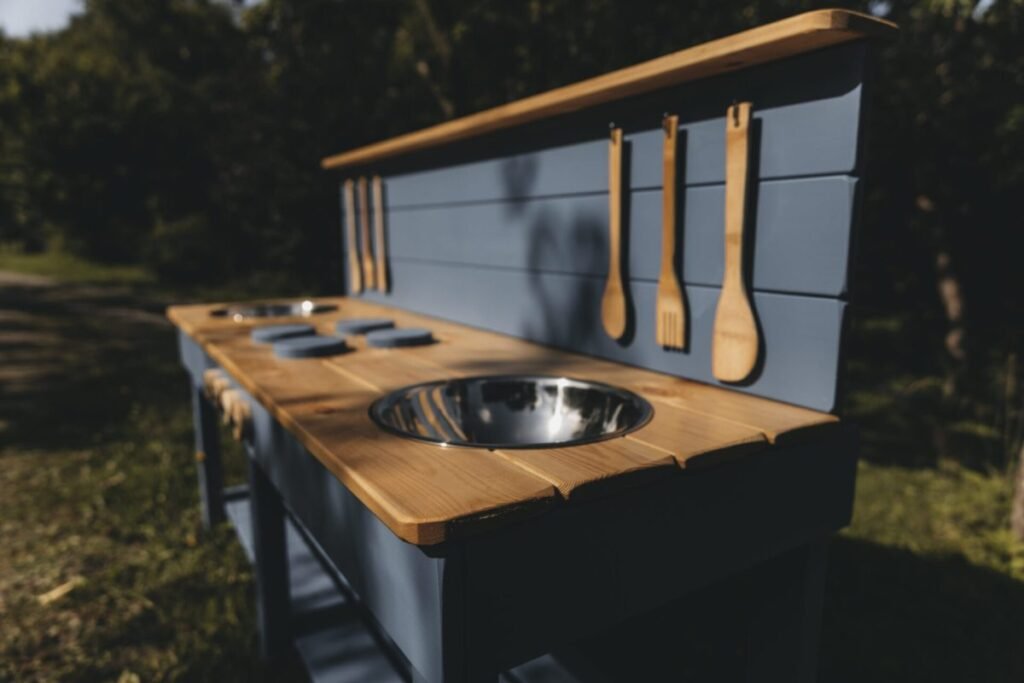
Built for the kind of play described here. Solid spruce, two lift-out steel sinks, a rail at child height, eleven colours, delivered assembled. See the four kitchens or read what a mud kitchen is if you are starting from the beginning.
Ready to choose a mud kitchen? Four sizes, eleven hand-painted colours, free UK delivery, delivered fully assembled. Browse the collection.