
Short answer
Forest school at home is not a curriculum, it is a corner of the garden and a change of rules: children lead, weather is not a reason to stay in, and real tools and real materials replace toys. You need a messy station such as a mud kitchen, a crate of loose parts, somewhere to sit, and a grown-up willing to stand back. This guide sets it up in a weekend, with a plan for the first month that works in an ordinary British garden.
Forest school places are wonderful and scarce: a morning a week, if your area has one at all. The good news is that most of what makes forest school work is an attitude, not a woodland, and the attitude fits in a back garden. Here is the honest version of doing it at home, from a company that spends its days building the messy station.
What forest school actually is
Forest school is a Scandinavian import with a UK association and trained leaders, built on six principles: regular sessions over time, a natural setting, managed risk, a qualified leader, child-led learning, and development of the whole child. At home you will not have a qualified leader or a woodland, and that is fine. What you can copy is the part that changes children: long, repeated, child-led time outdoors in all weathers, with real materials and sensible risk.
What it is not: a set of laminated activities to work through. The whole point is that the child decides what the sticks are today.
The four stations of a garden forest school
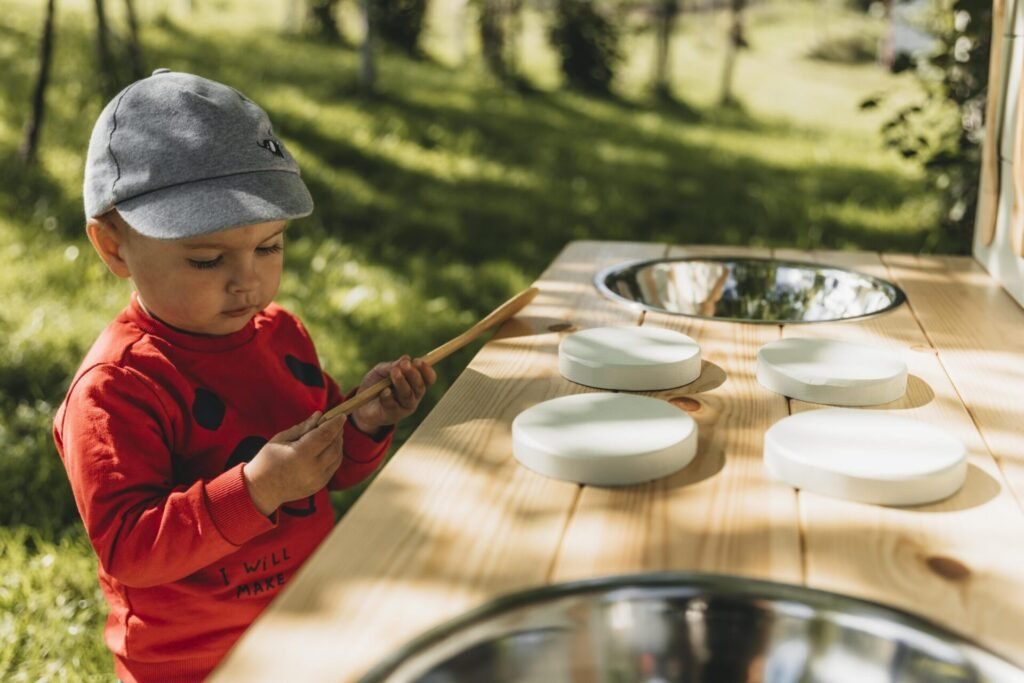
- The messy stationA mud kitchen is the anchor: mud, water, leaves and petals, with a worktop and sinks to process them. This is where most sessions start and end.
- The loose parts crateAn open crate of sticks, pine cones, conkers, stones, shells, offcuts and pegs. Restocked on walks, edited by season. The cheapest and most-used kit in the garden.
- The sitting spotA log, a bench or a mat under cover. Somewhere to gather, snack, and look at what was found. In forest school language, the base camp.
- The wild edgeA strip you deliberately stop tidying: long grass, a log pile, a bug hotel. Insects move in within weeks and become the resident wildlife programme.
Set it up in a weekend
- Pick the corner. Visible from the house, part shade, within a hose length of the tap. Our placement guide covers surfaces and sightlines.
- Station the mud kitchen with a jug, a washing-up bowl and utensils. No tap needed, a filled jug and a water butt do the job, see water play without plumbing.
- Fill the crate on one family walk: sticks in three sizes, cones, stones, anything with a texture. Add wooden spoons and a sieve from the charity shop.
- Agree the rules. Two are enough: nothing gets eaten, and we look after living things. Everything else is negotiable, that is the point.
The grown-up’s job: interested, not in charge
The hardest part of forest school at home is not the kit, it is the adult. The role is to be nearby, interested and slow to intervene. Practical translations:
- Ask “what is it?” about the mud pie instead of “shall we make it round?”
- When something wobbles or drips, count to ten before helping. Most problems get solved in eight seconds.
- Let sessions be boring in the middle. Boredom is the bridge to the good part.
- Dress everyone, including you, so that weather is irrelevant: waterproofs and wellies end most arguments before they start.
A first month of sessions
| Week | Invitation, not instruction | What tends to happen |
|---|---|---|
| 1 | Just the mud kitchen, water and soil, nothing else | Pies, soups, pouring. Let the basics establish themselves |
| 2 | Add the loose parts crate next to the kitchen | Decorating, sorting, counting, shops and cafés open |
| 3 | A flask of warm water and some old pans | Steam, potions, “cooking” gets serious, sessions get longer |
| 4 | One real tool: a trowel, a peeler for bark, a hand drill with help | Concentration you will not believe from a child who cannot sit through dinner |
After that, follow the child and the season. Our 25 play ideas and the winter play guide are there for flat days, and the free printable recipe cards hang on the rail for the “what shall we make” moments.
Risk, the forest school way
Forest school treats risk as something children learn to manage, not something adults remove. At home that means the risk lives at the level of the child: stir sticks and mud for a two-year-old, a peeler and a hand drill for a six-year-old with supervision. If you want the thinking written down, our safety guide covers paint, splinters and hygiene, and nurseries can take the free risk assessment template as a starting point.
Free printable
12 Mud Pie Recipe Cards
Twelve tried-and-tested mud kitchen recipes on printable cards, sorted by age. Laminate them, hang them on the rail, and the "what shall we make" question answers itself.
- Ages 2 to 10, marked on each card
- Real ingredients from a British garden
- A4, print at home, laminate if you can
Frequently asked questions
Can you do forest school without a forest?
Yes. The principles that matter at home are regular child-led time outdoors in all weathers with natural materials and manageable risk. A garden corner with a mud kitchen, a loose parts crate and a wild edge delivers all of that. A weekly walk to a park or wood tops up the materials and the scenery.
What age can children start forest school at home?
From steady walking, around 18 months to 2 years, with everything sized up: chunky loose parts, shallow water, full supervision. The sweet spot for a mud kitchen is 3 to 8, and older children stay engaged when real tools and real projects arrive.
What do children learn from forest school style play?
Fine and gross motor control, early maths through measuring and counting, language from role play, risk judgement, and the emotional regulation that comes from long unhurried play. The research and the EYFS links are in our guide to what children get from a mud kitchen.
How much does a garden forest school cost?
The loose parts crate and wild edge are free. Waterproofs are 15 to 30 pounds a child. The one considered purchase is the messy station: a handcrafted solid spruce mud kitchen is 499 to 599 pounds and lasts 5 to 10 years, which our cost per hour index puts among the cheapest garden equipment per hour of actual play.
The anchor piece: four sizes of handcrafted mud kitchen, eleven colours, delivered assembled. See the range or read the complete buying guide first.
Ready to choose a mud kitchen? Four sizes, eleven hand-painted colours, free UK delivery, delivered fully assembled. Browse the collection.