
Short answer
The best wood for a mud kitchen is a solid softwood, usually spruce or pine, treated with an exterior finish. It gives 5 to 10 years outdoors at a sensible weight and price. Hardwoods such as acacia and oak last longer but cost far more and are heavy. Avoid chipboard and MDF entirely, which swell and crumble within one wet season, and be wary of thin plywood, which delaminates at the edges. If you are building from pallets, use only heat-treated ones marked HT, never chemically fumigated ones marked MB.
Every mud kitchen that has ever failed early failed for one of three reasons: the wrong material, water sitting somewhere, or rusting fixings. This guide is about the first one, whether you are buying a kitchen or building one.
The materials ranked
| Material | Outdoor life | Weight | Cost | Verdict |
|---|---|---|---|---|
| Spruce (solid) | 5 to 10 years | Light | Low to medium | The best all-round choice, and what we build with |
| Pine (solid, treated) | 5 to 10 years | Light | Low | Good, but check it is properly kiln dried |
| Larch or Douglas fir | 8 to 12 years | Medium | Medium | Naturally durable, harder to source in usable sections |
| Acacia | 10 years plus | Heavy | High | Excellent, expensive, and heavy to move |
| Oak | 15 years plus | Very heavy | Very high | Overkill for a mud kitchen, and it stains from steel fixings |
| Exterior plywood | 3 to 5 years | Light | Low | Acceptable if edges are sealed properly. Most are not |
| Standard plywood | 2 to 4 years | Light | Very low | Delaminates from the edges inwards |
| Chipboard or MDF | One season | Medium | Very low | Do not. It swells, crumbles and cannot be repaired |
| Reclaimed pallet timber | 3 to 8 years | Light | Free to low | Fine if heat treated and properly finished |
Why spruce, specifically
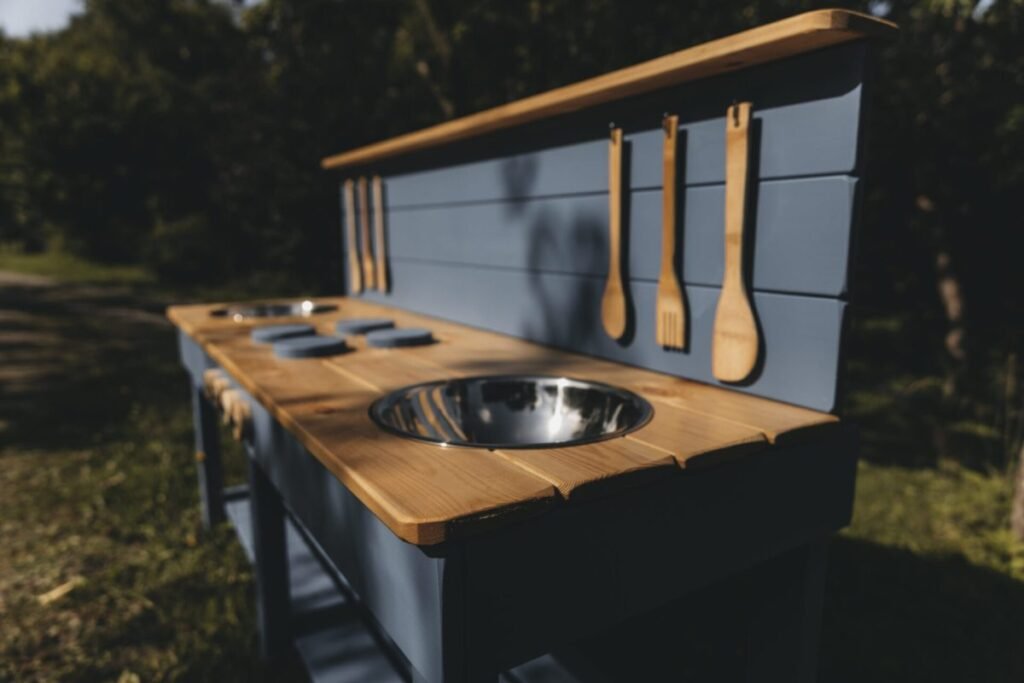
Spruce is what most European workshops building outdoor children’s furniture settle on, and the reasons are practical rather than romantic. It is dimensionally stable, so it does not twist and cup as much as cheap pine when it goes through wet and dry cycles. It is light enough that a 150 cm kitchen can be carried by two adults. It sands to a genuinely smooth, splinter-free surface, which matters enormously on something children lean on. And it takes an exterior coating evenly, which is what actually delivers the weather resistance.
No softwood is naturally rot-proof. Spruce works because of the combination: solid sections, a good finish, and no water traps in the design. Take away the finish and it will grey and soften like anything else.
Why chipboard and MDF are not an option
Both are wood fibre held together with adhesive. Outdoors, water gets into the fibre, the fibre swells, the adhesive lets go, and the panel turns into something with the texture of wet cereal. It cannot be sanded back, cannot be re-coated, and cannot be repaired. One winter is often enough.
The catch is that “wooden mud kitchen” in a product listing does not mean solid wood. Ask what the panels are. If the answer is vague, assume the worst and move on. This is the single most useful question when comparing budget kitchens, and it is covered further in our wooden versus plastic comparison.
Building from pallets: what to check
Pallet mud kitchens are a genuinely good project, and the timber is usually a decent softwood. Two things matter.
- Check the stamp. Under the international ISPM 15 scheme, pallets in international trade are marked. HT means heat treated and is safe to use. MB means methyl bromide fumigation: do not use it for anything children touch.
- Check where it has been. Avoid pallets that have carried chemicals, and anything stained or oily. Clean, dry, unstained pallets from a garden centre or builders merchant are the ones you want.
- Take it apart properly. A pallet buster or a reciprocating saw between the boards saves the timber. Levering with a crowbar splits it.
- Plane or sand every surface a child will touch. Pallet boards are rough sawn and will splinter.
- Seal every cut end. This is where water enters, and pallet builds have a lot of cut ends.
- Use stainless or coated exterior screws. Plain steel will rust, stain and split the timber within two winters.
If you are weighing a self-build against buying, we ran the real numbers in DIY mud kitchen versus buying one.
Should the timber be pressure treated
Modern pressure treatment for garden timber in the UK uses copper-based preservatives rather than the old CCA formulations that contained arsenic, and treated decking and fence timber is widely used around children. It is a reasonable choice for the legs and any part in contact with the ground.
Our own preference for the worktop and the body is untreated solid timber finished with an exterior coating, because it gives a cleaner surface for hands and food play and is simpler to re-coat and repair. Whichever route you take, the part that touches wet ground is the part worth protecting hardest.
The fixings matter as much as the timber
This is the detail that separates a kitchen that lasts eight years from one that lasts three, and it costs about £4 to get right. Plain steel screws rust, and rust expands, which splits the timber from the inside and leaves black stains running down every panel. Use stainless steel or properly coated exterior screws throughout, including the utensil hooks. If you are inspecting a kitchen to buy, look at the screw heads: orange means someone saved a few pounds.
Frequently asked questions
What is the best wood for a mud kitchen?
Solid spruce or pine, finished with an exterior oil or paint. They give 5 to 10 years outdoors, stay light enough to move, sand splinter-free and take a coating well. Hardwoods like acacia last longer but cost far more and are heavy. Never use chipboard or MDF.
Can you use pallets to build a mud kitchen?
Yes, provided the pallets are stamped HT for heat treated. Never use pallets stamped MB, which have been fumigated with methyl bromide. Sand every surface a child touches, seal all cut ends, and use stainless or coated exterior screws throughout.
Is plywood good for a mud kitchen?
Only exterior-grade plywood with every edge properly sealed, and even then expect 3 to 5 years. Standard interior plywood delaminates from the edges inwards within two or three wet seasons. Solid timber is more forgiving because it can be sanded and re-coated indefinitely.
Does mud kitchen wood need to be treated?
Yes. No softwood is naturally rot-proof. An exterior wood oil, preserver or acrylic paint keeps water out of the grain, and a fresh coat every one to two years is what turns a 3-year kitchen into a 10-year one. Cut ends and legs matter most.
We build ours in solid spruce. Sanded splinter-free, hand-painted in outdoor acrylic, stainless fixings throughout, delivered fully assembled. See the four sizes or read the weatherproofing guide.
Ready to choose a mud kitchen? Four sizes, eleven hand-painted colours, free UK delivery, delivered fully assembled. Browse the collection.