
Short answer
The mud kitchen accessories that get used every day are a set of metal pans and a kettle, wooden spoons, a sieve, a ladle, a whisk, a jug for water, and a few moulds such as muffin tins and ice cube trays. Charity shops supply nearly all of it for £5 to £15 total. What does not get used: matching plastic toy sets, anything that rusts shut, and delicate items nobody is allowed to break. Add loose natural materials, which cost nothing and matter more than the equipment.
We have delivered a lot of mud kitchens and seen a lot of gardens afterwards. This is what is actually in the pots six months later, and what has quietly gone in the bin.
The core kit, in order of how much it gets used
| Item | Why it earns its place | Where to get it |
|---|---|---|
| Small metal saucepans | Stirred, carried, filled and banged. The single most used item | Charity shop, £1 to £3 |
| Wooden spoons | Every recipe starts with one. Buy several | Supermarket, £2 for a set |
| Sieve or colander | Turns soil into a process rather than a heap | Charity shop, £1 |
| Jug | Water gets carried in this constantly | Charity shop, £1 |
| Ladle | Portioning is the whole restaurant game | Charity shop, £1 |
| Whisk | Mud and water whisked together is inexplicably compelling | Charity shop, £1 |
| Muffin tin | Mud cakes come out of moulds. This is the top of the mould hierarchy | Charity shop, £2 |
| Ice cube tray | Small portions, counting, tiny cakes | Anywhere, £1 |
| Old kettle | Pouring, pretend tea, and it looks like a real kitchen | Charity shop, £2 to £4 |
| Pestle and mortar | Grinding petals into “spice” occupies children for surprisingly long | Charity shop, £3 |
Total realistic outlay: £5 to £15 from charity shops. That is not a frugality flourish, it is the better option. Real metal pans behave properly, survive being dropped, look like the ones in your kitchen, and nobody minds when they get scratched.
What does not get used
- Matching plastic toy kitchen sets. Too light to stir with, they crack in frost, and they go chalky in sunlight. Children reach past them for the metal pan.
- Anything with a hinge or a spring. Mud gets into the mechanism, it seizes, and it becomes rubbish within a month.
- Cheap tinplate. Not stainless. It rusts through in one winter and leaves orange stains.
- Anything precious. If a child can sense they are supposed to be careful with it, they will avoid it entirely.
- Sharp knives and graters, for obvious reasons. A blunt butter knife does everything needed.
- Novelty sets sold as “mud kitchen accessories” for £25. The same items cost £6 in a charity shop, and are usually better made.
Loose parts: the bit that actually matters
Equipment lets children cook. Loose parts give them something to cook with, and this is where the play either takes off or flattens. Keep a crate beside the kitchen and restock it seasonally.
| Season | What to collect |
|---|---|
| Spring | Blossom, dandelions, fresh grass clippings, early herbs |
| Summer | Petals, mint, rosemary, lavender, seed heads, small windfall fruit |
| Autumn | Conkers, acorns, leaves in every colour, beech mast, fallen apples |
| Winter | Bare twigs, pine needles, holly berries kept out of reach, ice, frost |
| All year | Pebbles for over-threes, bark chips, sand, dried pasta, oats, cocoa |
Two safety rules worth teaching on day one: nothing gets eaten, and nothing gets picked from a neighbour’s garden. Some common garden plants including yew, foxglove and laburnum are toxic, so walk round once together and agree which plants are for cooking and which are for looking at. The RHS publishes guidance on harmful garden plants.
Storage that stops it becoming a heap
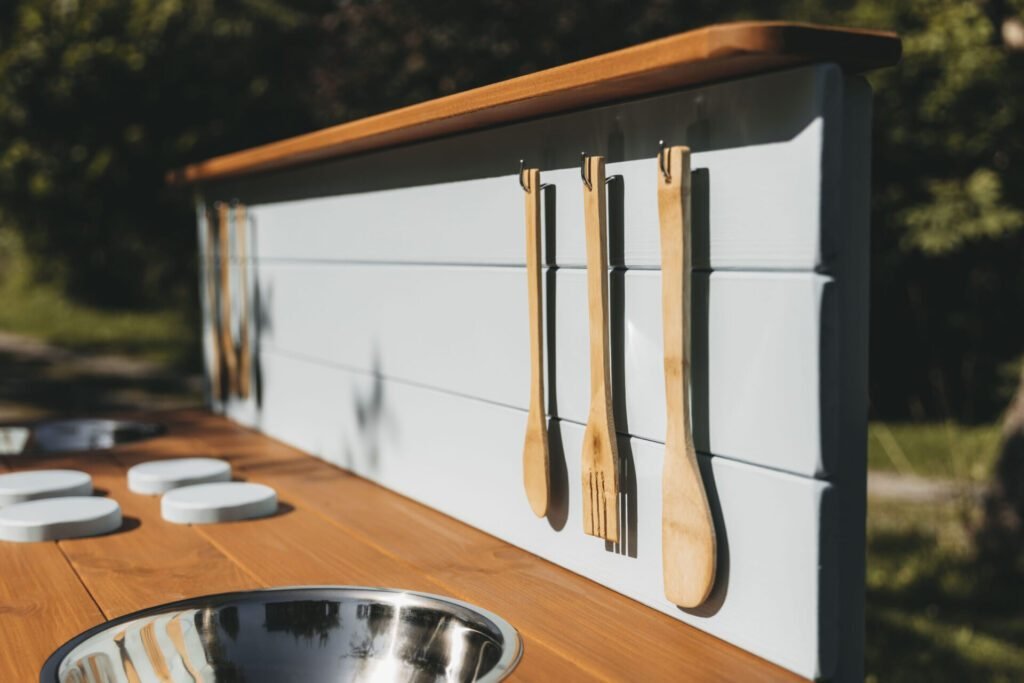
- Hang what you can. Hooks along the utensil rail keep spoons, ladles and sieves visible, and visible equipment gets used.
- Use open crates for loose parts. One crate per material type, at child height, so tidying is sorting rather than a chore.
- Keep pans on the shelf upside down. They do not fill with rain and they dry between sessions.
- Give the mud its own lidded tub. Keeps cats out and stops the borders being excavated.
- Do a termly clear-out. Anything rusted, seized or broken goes. Half the accessories in an old mud kitchen have not been touched in a year.
Ten pounds, one Saturday morning
If you are starting from nothing, this is the shopping list we would give a friend. One charity shop, twenty minutes: two small saucepans, a kettle, a sieve, a ladle, a whisk, a jug, a muffin tin, and as many wooden spoons as they have. Then a bag of peat-free topsoil from the garden centre and a lidded tub. That is a fully equipped mud kitchen for about £15 all in, and it will be better stocked than most sets sold online for four times the price.
Ideas for what to do with it are in our 25 play ideas and mud pie recipes, and the mud itself is covered in how to make mud for a mud kitchen.
Frequently asked questions
What accessories do you need for a mud kitchen?
Small metal saucepans, wooden spoons, a sieve, a ladle, a whisk, a jug, a muffin tin and an old kettle cover almost everything children do. Charity shops supply the lot for £5 to £15. Add loose natural materials such as petals, leaves and conkers, which matter more than the equipment.
Are plastic toy sets any good in a mud kitchen?
Not really. Plastic toy pans are too light to stir stiff mud with, crack in frost and go chalky in sunlight within a season. Children consistently reach past them for a real metal pan. Second-hand metal kitchenware is cheaper, more durable and more convincing.
Where can I buy mud kitchen accessories cheaply?
Charity shops are the best source by a wide margin: metal pans, sieves, ladles, kettles and muffin tins for £1 to £3 each. Car boot sales and your own kitchen drawer work equally well. Purpose-sold mud kitchen accessory sets cost several times more for the same items.
How do you store mud kitchen accessories outside?
Hang utensils on hooks so they stay visible and drain, store pans upside down on the shelf so they do not fill with rain, and keep loose natural materials in open crates at child height. Keep prepared mud in a separate lidded tub, and clear out rusted or seized items each term.
Every kitchen we build comes with a utensil rail and hooks as standard, plus two lift-out steel sinks and a full-width shelf. Four sizes, eleven hand-painted colours, free UK delivery. See the range.
Ready to choose a mud kitchen? Four sizes, eleven hand-painted colours, free UK delivery, delivered fully assembled. Browse the collection.